We had 38 in attendance President Don opened the meeting promptly at 12:00, with a little jab at a couple of members who continued to carry on a conversation. Bob Pearson led the club in O Canada.
President Don provided a land acknowledgement prefaced by a statement, that his family has 5 generations residing on the traditional territories of the Blackfoot Confederacy, Tsuut’ina, Stoney Nakoda, and Métis Nation of Alberta Region 3. President Don emphasized: “Our work toward reconciliation will be a long one, and I hope you will join me on it.” Les Morgan introduced our guests today; Bina Kainett, Jackie Arcega, Gerrad Cartier, Bill Fric, and proposed new member Melanie Todd.
Terry Felton introduced our speaker Ron Barmby - Why is Net Zero CO2 – Pointless, Unachievable & Unfair
Ron Barmby is a Professional Engineer with a Master’s Degree with a focus in Geosciences. His four-decade geoscience career took him to over 40 countries on five continents. It involved most of the technical disciplines also used in climate science and net-zero technology; including classical physics, thermodynamics, geology, paleoclimatology, computer modelling, satellite remote sensing, metallurgy, economics, and statistical methodology. His first book, Sunlight on Climate Change: A Heretic’s Guide to Global Climate Hysteria, led to world-class scientific experts sharing their research, enabling Ron to author Sunset on Net Zero: A Heretic’s Guide to the Futile CO2 Target.
Ron, included several experts as references in his presentation; Doctors; John Clauser, Steven Koovin, Roy Spencer, William Happer, James Wallace, John Christy Joseph and Canadian W.A. Wijngaarden. (And my favorite Winston Churchill) Ron's presentation challenged several commonly held assumptions about climate change and questioned whether current Net Zero policies are achievable, economically sustainable or even fair to different countries and communities. He organized the presentation around central arguments: that Net Zero is potentially pointless, unachievable and unfair, and that a broader understanding of the factors influencing global temperatures is needed when developing climate and energy policies.
Key Points
Understanding CO₂ and the Greenhouse Effect The presentation began with an explanation of how energy from the sun reaches the Earth and how the planet releases energy back into space. The speaker described how carbon dioxide (CO₂) absorbs some of the longwave infrared radiation emitted by the Earth's surface. This process is part of the greenhouse effect, through which greenhouse gases influence the Earth's temperature. The presentation discussed the relationship between atmospheric CO₂ concentrations and warming, arguing that the warming effect increases logarithmically rather than in a straight-line relationship. It cited research by W. A. van Wijngaarden of York University and William Happer of Princeton University, suggesting that doubling atmospheric CO₂ from approximately 420 parts per million would result in an average global temperature increase of about 1°C. Conclusion • Greenhouse gases help keep Earth warm enough for life. • CO₂ is one of several greenhouse gases. • Without a greenhouse effect, Earth would be much colder.
Other Factors Influencing Global Temperatures 1. The Pacific Ocean and El Niño/La Niña The El Niño Southern Oscillation (ENSO) was presented as an important influence on global temperatures. He described La Niña as a period when heat is stored in the ocean, while El Niño releases some of that energy, contributing to temporary global warming. These cycles can influence global temperature trends over periods of years and should be considered when evaluating longer-term climate patterns. 2. Clouds and Their Influence on Solar Energy Clouds reflect incoming sunlight back into space, influencing how much solar energy reaches the Earth's and small changes in low-cloud coverage could have a substantial influence on global temperatures and suggested that clouds play an important role in regulating the Earth's climate. 3. The Urban Heat Island Effect Urban development and changes in temperature measurement locations can influence recorded temperature trends. Ron cited research suggesting that the transition of some weather stations from rural or wilderness locations to developed areas has affected historical temperature measurements. Conclusion Together, these three factors were presented as reasons to consider a wider range of influences when interpreting global temperature data. • He questions the reliability of many climate projections and argues that some models rely on assumptions that have not been adequately verified by observations. • Actual observations should continually be compared against projections. • Long-term predictions depend heavily on those assumptions.
The Economic Challenges of Achieving Net Zero The second major theme examined the feasibility and cost of reducing CO₂ emissions. Ron questioned whether carbon capture technology can be deployed economically at the scale required to meet Net Zero targets. Two approaches were discussed: 1. Direct air capture: Removing CO₂ directly from the atmosphere was described as an expensive process, particularly if the captured carbon must subsequently be stored. 2. Carbon capture and storage: Ron illustrated Alberta's Quest carbon capture project as an example, noting its capacity to store approximately one million tonnes of CO₂ annually while questioning the economic viability of expanding this technology substantially. The presentation then examined alternatives to conventional fossil-fuel energy. • Wind and solar power were criticized for their costs, reliability and disposal requirements. • Biofuels were another area of concern, with the presentation questioning whether their overall production and processing emissions provide the environmental benefits often attributed to them. • The discussion also considered the practical limitations of transitioning to electric vehicles and residential heat pumps in colder climates such as Alberta. • Cold temperatures can affect battery performance, vehicle range and charging times. Heat pumps have reduced efficiency during extreme cold weather • Another concern was the amount of mining and mineral production required to support a large-scale transition to renewable energy and electrification. Conclusion • Net Zero CO2 is unachievable because the green technology alternatives are unreliable and unaffordable. Wind and solar power triple electricity costs, building fully electric vehicles produces at least one-half of CO2 emissions they are meant to avoid and heat pumps will leave you dangerously cold in the winter. Green hydrogen, air capture CO2, and carbon capture and storage are prescriptions for national bankruptcy. • The Quest project was used as an example of the costs and scale involved
Is Net Zero Fair to All Countries? The final section examined the economic implications of climate policies for developed and developing countries. Ron compared changes in CO₂ emissions and global economic output between the G7 countries and China since 2000. He argued that while G7 countries had reduced their emissions, their share of global GDP had also declined. In contrast, China's emissions and share of global GDP had increased substantially. Ron used these comparisons to question whether countries that impose more expensive energy policies could face disadvantages in global competitiveness, particularly when other countries continue to expand their use of conventional energy sources. The broader argument was that energy affordability and reliability are important considerations in economic development and that climate policies should account for their consequences for households, businesses and national economies.
A Thought-Provoking Discussion The presentation offered members an opportunity to consider the complex relationship between climate science, energy policy, economic competitiveness and environmental objectives. Regardless of where members stand on Net Zero, the discussion highlighted the importance of examining the assumptions behind public policy, understanding the costs and practical limitations of proposed solutions, and considering how energy decisions affect communities both locally and internationally. Climate change and the transition to lower-emission energy systems remain significant global issues. The presentation provided one perspective on these challenges and encouraged members to look beyond headlines and consider the scientific, technological and economic questions involved. The central takeaway: Decisions about our energy future involve more than setting emissions targets. They require careful consideration of scientific evidence, technological capabilities, economic consequences and the needs of communities around the world. Overall Conclusion • CO₂ contributes to warming. Net Zero CO2 is pointless because we have now confirmed by satellites that 90% of CO2 warming has already happened. • CO2 is not an existential threat, but Clouds, El-Nino, and human habitation are significant drivers of global warming that are often ignored. • Decisions should be based on evidence, practicality, and measurable benefits.
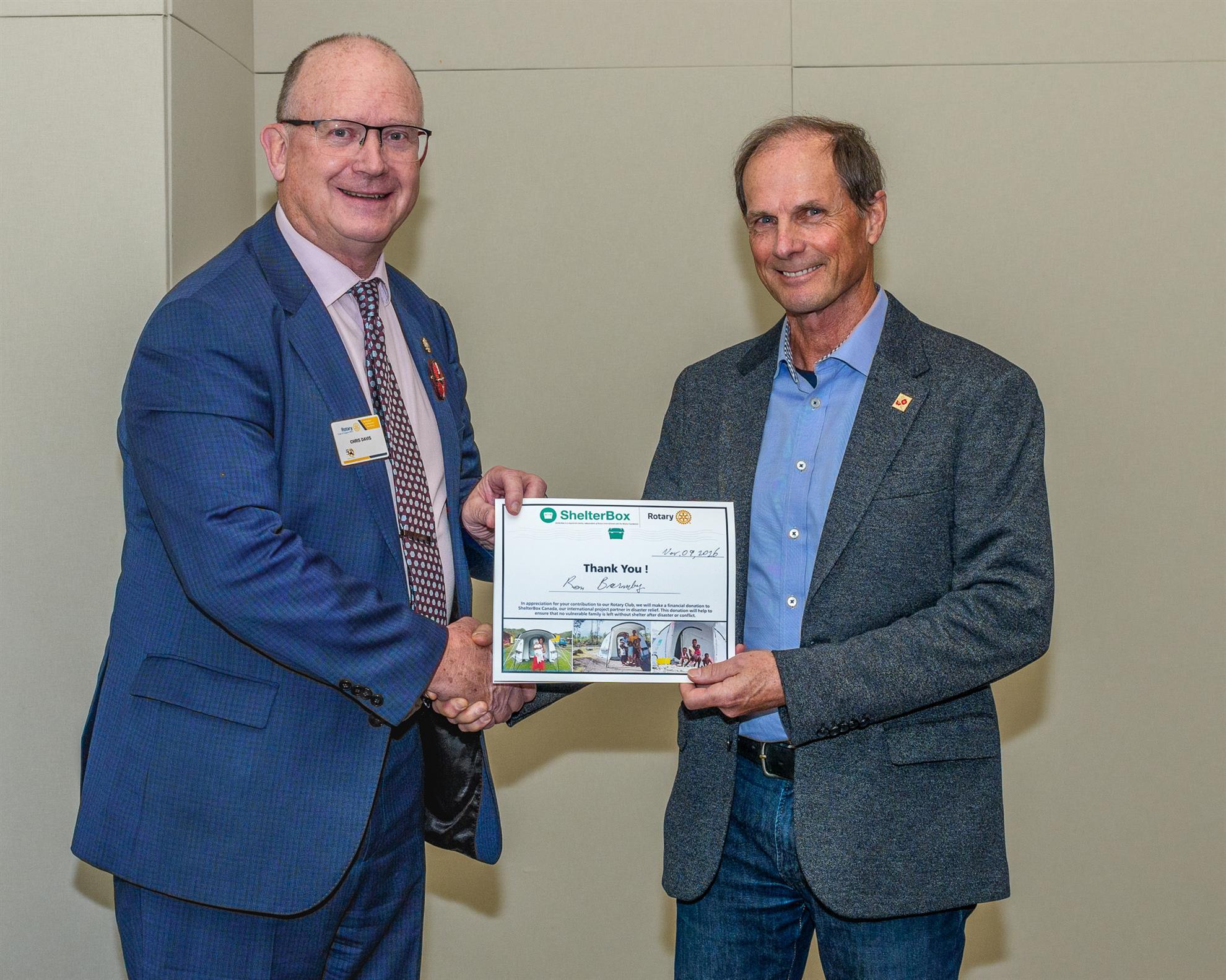
Several questions were skillfully answered and the writer notes that rather than repeat the question for clarity purposes, those concerned could perhaps turn up their hearing aids. Chris Davis expressed the appreciation of the club and suggested that perhaps the club consider another speaker to present an alternative perspective and discuss arguments presented today. He also stated a donation would be made in Ron Barmby’s name to ShelterBox (started by a Rotarian).
As President Don closed the meeting with the singing of our Four-Way Test.
President Don expressed his appreciation for those involved with today’s set up; Ron Brookes, Les Morgan, Gord Cox, Mike Carlin. The meeting was adjourned at 1:00 pm


 Ron Barmby is a Professional Engineer with a Master’s Degree with a focus in Geosciences. His four-decade geoscience career took him to over 40 countries on five continents. It involved most of the technical disciplines also used in climate science and net-zero technology; including classical physics, thermodynamics, geology, paleoclimatology, computer modelling, satellite remote sensing, metallurgy, economics, and statistical methodology. His first book, Sunlight on Climate Change: A Heretic’s Guide to Global Climate Hysteria, led to world-class scientific experts sharing their research, enabling Ron to author Sunset on Net Zero: A Heretic’s Guide to the Futile CO2 Target.